
INFORMING POLICY & IMPLEMENTATION

NYS ADAPTATION PLANNING & POLICY
New York State is developing its first-ever statewide Adaptation and Resilience Plan, an important opportunity to shape how communities across the state prepare for climate impacts, protect critical infrastructure and ecosystems, and build a more resilient future. At our Fall Convening, we hosted a session designed to help re-energize practitioners and kick start this process, inviting environmental sociologist Ankit Bhardwaj to share research and lessons learned from sub-national climate planning efforts around the world. Participants explored successful engagement strategies and case studies that demonstrated how inclusive, action-oriented planning can lead to stronger outcomes for communities, local economies, and long-term resilience. These conversations set the stage for rich small-group discussions that generated ideas and recommendations to help inform New York State’s Adaptation and Resilience Plan. The Network continues to work closely with state agencies to play an ongoing role in the plan’s development and help ensure it reflects the needs, expertise, and experiences of practitioners across New York.
In addition, the Network has played an active role in the roll out of the New York State Extreme Heat Action Plan, partnering with the Extreme Heat Coalition and NYS Department of Environmental Conservation to host a webinar about the plan’s launch and the opportunity to inform its implemntation.
CONGRESSIONAL BRIEFINGS
The New York State Adaptation Practitioners Network has hosted two educational briefings for the New York State congressional delegation.
The first briefing, held in 2020, explored the types of resilient infrastructure investments that would most benefit New York State communities through the Bipartisan Infrastructure Law. Recommendations were captured in the collectively developed Principles of Resilient Infrastructure.
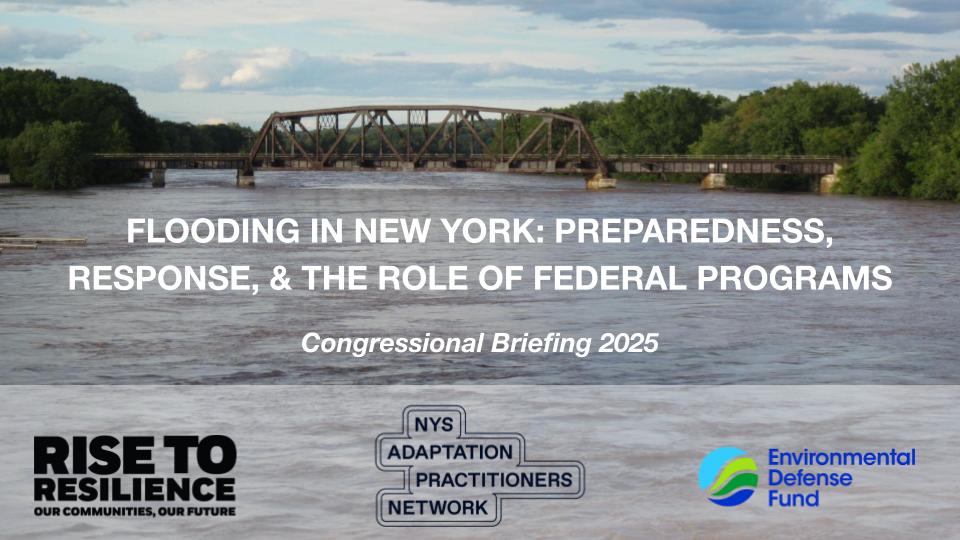
In 2025, amid the rapid elimination of federal programs, we hosted a second briefing in partnership with the Environmental Defense Fund and Rise to Resilience to educate lawmakers and policy staff on the role of federal flood mitigation and disaster response programs across New York State communities. We convened partners from across disciplines including a former mayor, emergency managers, and disaster preparedness organizations to share stories illustrating the kinds of projects and community resources which depend federal programs.
POLICY UPDATES & CONNECTION TO ADVOCATES
The Network’s Policy Working Group meets monthly and provides the full Network with timely state and federal policy updates through events and in our monthly newsletter. Updates include the introduction of new legislation, opportunities for public comment, budget implications, and strategies for navigating evolving political landscapes.
In complement to these updates, the Working Group bridges the gap between practitioners and advocates by connecting organizations eligible for advocacy with opportunities to engage and by sharing practitioner research and on-the-ground insights with advocates. We also regularly invite advocates to share their policy priorities with the Network.
This work helps ensure that climate adaptation policy is informed by real-world implementation experience and community needs. By strengthening communication between practitioners and advocates, the Working Group supports more coordinated, informed, and effective resilience policy across New York State.
COLLABORATIVE RESEARCH
Research through and informed by the Network is driven by practice. By engaging practitioners from across New York State, captures information that reflects real-world implementation challenges, emerging adaptation needs, and successful strategies. This collaborative approach ensures findings are relevant, actionable, and directly inform policies, funding programs, technical assistance, and climate resilience efforts across the state.
As a “network of networks,” the Network also connects researchers with professional associations, working groups, regional planning organizations, watershed groups, academic institutions, and state agencies. These connections make it possible to engage the right experts, gather insights from a wide range of disciplines, and develop research that would be difficult for any one organization to produce alone.
